1 - 20 of 173 Results

Date:
Alla Palamarchuk is a volunteer from Kryvyi Rih who has been actively supporting both military personnel and civilians since 2022. Her journey is full of inspiring moments, and she is eager to share them to highlight the importance of supporting the women volunteers who dedicate themselves to assisting others.

Date:
Viktoriia Yepifanova, 43, from Chernihiv, is dramatically changing her life. She is one of the first participants in the She Drives project to pass the practical exam and receive a category "D" driver's license.
Date:
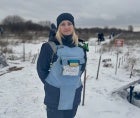
Tetiana Rubanka is a deminer and demining team leader at The HALO Trust, an international organization in Ukraine. One day, she changed her heels and dress for boots, a uniform and a detector, and has been dedicating herself to humanitarian demining for two years. Tetiana's main motivation for trying herself in a new field was the desire to clear the Ukrainian land of mines and unexploded ordnance so that the military and civilians could return to safe territory: “I believe that this is my mission, and I am glad that I can contribute by doing this.”
Date:
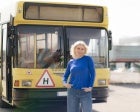
Tetiana Yurkevych works as a logistician at Epicentr K and volunteers at the Spilno children's center at one of the Kyiv passenger stations. Tatiana has completed all stages of bus driving training, passed the exams, obtained a category "D" driver's license, and is currently seeking a job in her new profession.

Date:
Happy Monday and UN Women in Ukraine are offering a free online course titled "Building My Own Path," designed for women's professional growth. This course is open to anyone interested in participating. It is part of the Women For The Future initiative, which aims to enhance the economic opportunities available to Ukrainian women.

Date:
The full-scale war has brought Ukrainian women not only losses and pain but also a challenge: to start anew. They are faced with the need to change professions, launch their businesses, and regain a sense of stability and control over their lives. It is from these urgent needs that the idea for the educational program Dream and Achieve was born—an initiative that has served as a safe starting point for many women navigating difficult circumstances.
Date:
Every day, millions of Ukrainians in cities and villages across the country live under the persistent threat of indiscriminate attacks by the Russian armed forces. Human and women’s rights organisations are among the first responders, providing both immediate and long-term support to affected civilians, including critical services for survivors of conflict-related sexual violence.

Date:
Mariupol is the city that Iryna Hadar and her son were forced to leave due to Russia’s full-scale invasion of Ukraine in 2022. She survived shelling, a dangerous escape, and life in uncertainty. Eventually, Iryna found a new home and rediscovered herself. Her story is not only about loss, strength, and courage—it is also about how support from UN Women in Ukraine and The United Nations Women’s Peace and Humanitarian Fund (WPHF) helped her recognize the violence she had experienced before the war.

Date:
The beekeeping family of Olga and Oleksandr Krysiuchenko continues to work and build their future in Pryozerne, a village in the frontline region of Kherson. The couple has been engaged in beekeeping for 7 years, and since the Russia’s full-scale invasion of Ukraine, they have not only managed to stay afloat but have also turned their passion into a business.

Date:
The war shattered Oksana Posternak’s life into a thousand pieces—her hometown of Veletenske in Kherson was occupied, she endured a difficult evacuation, constant relocations, the destruction of her home by enemy shelling, and the inability to return. Having lost everything, she was left with pain and emptiness. But one thing remained unchanged—her talent for creativity. She never imagined that her hobby could become her profession.

Date:
The participants of the She Drives project continue learning about the bus driving profession and gain valuable insights directly from transportation companies.

Date:
Olga Klushanova knows what it means to start over from scratch. She lost her home for the first time in 2014 when the war forced her to leave her native Donetsk and relocate to Kostiantynivka. In 2022, Russia’s full-scale invasion of Ukraine once again tore her away from her everyday life. Together with her family, Olga moved to Dnipro, leaving behind everything that had once seemed permanent. She lost a lot but refused to let circumstances break her. Read below about how support from UN Women Ukraine and The United Nations Women’s Peace and Humanitarian Fund (WPHF) gave her the strength to move forward.

Date:
Alina Shadura, 44, is from Kharkiv. She is a lawyer who has spent many years working at a charitable foundation, providing psychosocial support to women who have experienced gender-based violence. Following the onset of the full-scale Russian invasion, Alina and her family relocated to Cherkasy, where they lived for three years. Alina is one of the 100 participants in the She Drives project aimed at training and employing female bus drivers.

Date:
‘The idea was my husband’s. We position ourselves as 'producers of cheese from happy cows’ milk.' The cows in the Hutsul region graze freely; they roam wherever they like, eat fresh grass and are supplemented only with pure hay without additives. From this milk, we craft our cheese. Here, in Shepit village, most people in the area had a tradition of keeping cows. We decided that this tradition was worth preserving, so we started buying milk from local residents...
Date:
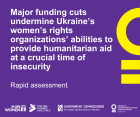
Women-led and women’s rights organizations (WROs) in Ukraine have been severely impacted by funding suspensions by the United States (U.S.), a new survey by UN Women, the Apparatus of the Government Commissioner for Gender Equality Policy of Ukraine, and the Gender in Humanitarian Action Working Group, reveals.
UN Women calls for more direct, flexible, and long-term funding to women’s rights organizations to ensure life-saving programs for women and girls to meet sudden funding gaps.
Date:
‘By profession, I am a math and physics teacher and worked in the city. However, I always dreamed of owning a house in a village. In 1998 or 1999, I came across the concept of rural green tourism in Ukraine. It fascinated me, so I began attending conferences and talking to people who already had experience in this field. I realized it could become an exciting hobby for me...

Date:
The She Media School for Women's Leadership has announced a new call for applications for the 2025 program. The application form can be filled in until March 25. The educational program is aimed at improving management and communication skills, which will be taught in theoretical and practical sessions over three months in offline and online formats.
Date:
‘The idea emerged about three years ago. We were united by gender issues: women’s rights, equality, their realization in the world, and their place in civil society... It so happened that this has already become our dream. Iryna and I have a generational difference, but these generations have come together, and their dreams have intertwined into a common goal — we strive to bring our ideas to life, which are filled with philosophy...

Date:
On March 7, the national campaign “Give Yourself a Chance” was launched to help Ukrainian women navigating in career, freelancing opportunities, and business ventures. The campaign includes a podcast and manifesto, as well as educational opportunities — an educational online course and a mentorship program — that will support women at different stages of their professional development.

Date:
‘My story is both ordinary and extraordinary. Our great-grandparents had vineyards. My great-grandfather made wine and kept a wine cellar. In 2010, my husband and I received a wedding gift from our parents — a plot of land and a small country house. From that moment, we began searching for our path. We wanted to do something that was both interesting and profitable...